

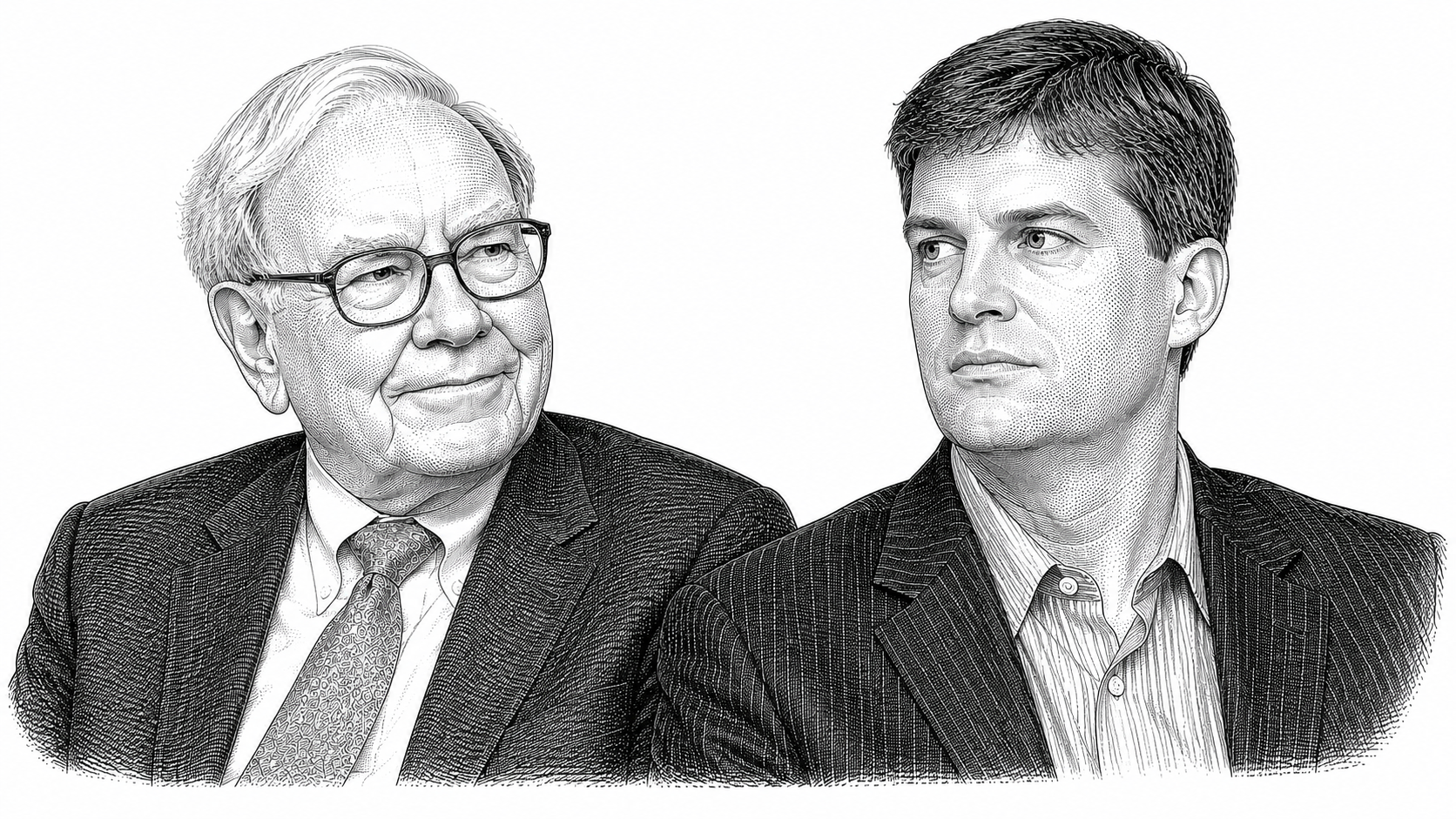
Warren Buffett is sitting on $397 billion in cash. Michael Burry has bet $1 billion against artificial intelligence stocks. Both men have built legendary reputations on being right when everyone else is wrong. Now they face a problem that no amount of past success can solve: the market does not care how right you are if you are early.
Buffett's diagnosis is sound. The gambling mood he observed to CNBC is real. Palantir trades at a P/E ratio above 150. Nvidia's valuation has decoupled from its revenue trajectory. The AI boom exhibits every characteristic of speculative excess. His refusal to deploy capital into this environment reflects disciplined thinking.
Burry's put options on Nvidia and Palantir show the same conviction. A billion dollars in bets against the market's most hyped stocks is not a hedge. It is a statement. Both investors believe that gravity will reassert itself and valuations will collapse.
They are probably right.
The problem is that being right and being vindicated are not the same thing. Markets can remain irrational longer than investors can remain solvent. This is not a theoretical concern for Buffett and Burry. It is a practical one that will define their legacies.
Consider Buffett's position first. He is 94 years old. Berkshire Hathaway is a $900 billion company with expectations. Every quarter that passes with $397 billion in cash generates questions.
Why hold this much liquidity? What opportunities are you seeing? What are you afraid of? These questions intensify if the market continues climbing. At some point, patient capital stops looking like wisdom and starts looking like missed opportunity.
The Goldman Sachs trade Buffett executed during the 2008 crisis illustrates both the promise and the peril of his approach. He invested when the financial system was collapsing, riding a multi-year recovery to a $3.7 billion profit. But he had several advantages: a clearly defined catalyst (the financial system stabilising), a multi-year timeframe, and no pressure from shareholders demanding quarterly performance.
Today's situation is different. There is no clear catalyst for an AI correction. The timeframe is uncertain. And Berkshire, despite Buffett's control, operates under shareholder scrutiny and a new CEO. Underperformance compounds over time. If the S&P 500 returns 12% annually while Berkshire holds cash earning 5%, that gap becomes a narrative problem. After three years, it becomes a performance problem.
Burry's challenge is more acute. His puts have expiration dates. Options decay in value. A one-year correction is a validation of his thesis. A three-year correction means his positions have expired worthless and he has to rebuy at higher prices. Being right about direction means nothing if the timing is off. He is not playing for vindication. He is playing for profit within a specific window.
This is the trap that ensnares even legendary investors. The market can remain irrational longer than the rational investor can afford to wait. Timing the market goes against everything Buffett has preached about long-term investing, yet here he sits, implicitly timing the market by refusing to deploy capital.
The deeper question is whether they are facing a genuine bubble or a genuine paradigm shift. AI capabilities are improving exponentially. The TAM is genuinely enormous. The returns on AI infrastructure deployment are real. Nvidia's business fundamentals, while expensive, are actually solid. What looks like irrational exuberance to a 94-year-old value investor might simply look like the future to everyone else.
History is littered with investors who were right about the direction but wrong about the timeline. They diagnosed the bubble correctly but missed the doubling that preceded the collapse. They called the correction accurately but exited the winners too early.
Related reading
- AI is making it easier for rogue states to hide money and evade sanctions
- Mercer survey finds 99% of CEOs expect AI-driven layoffs
- OpenAI's Altman says AI unlikely to trigger a jobs apocalypse
Buffett and Burry have built careers on being right. The question that will define the final chapters of those careers is whether they can afford to be right too early. Markets do not reward prescience without punctuality. And patience, however disciplined, has limits.
The cash will eventually be deployed. The puts will eventually expire. When that happens, Buffett and Burry will discover that being right was never the hard part. Surviving the wait was.